
LOADING
A Centre of Excellence for Faculty Development Programmes

The Teacher Training Cell (TTC) at TCET is a strategic initiative aimed at enhancing academic excellence and responsiveness to the evolving needs of education. Leveraging resources such as SWAYAM, NPTEL, and DIKSHA, the TTC offers comprehensive faculty development programs that cater to the diverse needs of educators. These programs include structured training, workshops, and seminars that focus on enhancing teaching, learning, and research skills. The TTC's approach is informed by various analyses, including MOST analysis, PESTLE analysis, RACI matrix, and risk analysis. The TTC acknowledges the contributions of various stakeholders, including faculty members, industry partners, and administrative staff.
By empowering faculty members with the skills, knowledge, and competencies required to succeed in a rapidly changing world, the TTC plays a critical role in shaping the future of education. The TTC fosters a community of scholars committed to academic excellence, innovation, and social responsibility, ultimately improving the quality of education, providing students with excellent career options, and elevating faculty credentials to global standards.
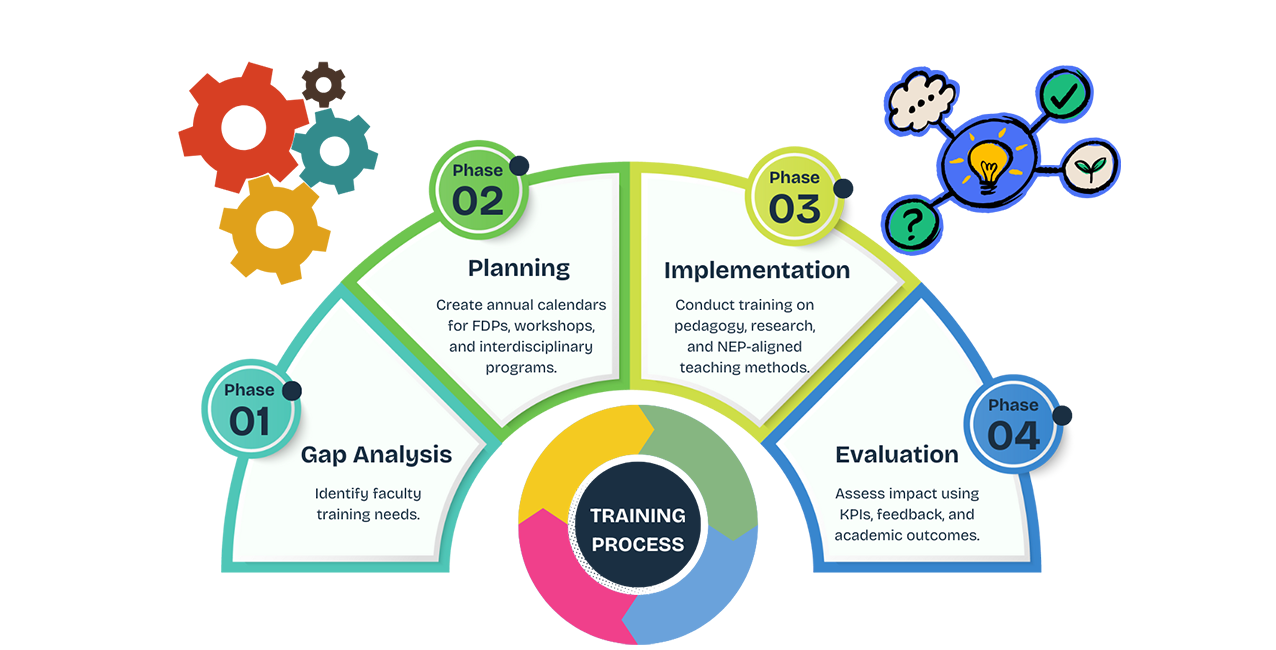
 Induction Training
(Pre-Service Training)
Induction Training
(Pre-Service Training) In-Service Training
 On Job Training
 Regular Training
Modules
Regular Training
Modules| Sr. No. | Department | Programme Title | Duration | Participants |
|---|---|---|---|---|
| 1 | AI&DS & AI&ML | ISTE Approved STTP: Building the Future with AI: From Industry Practices to Cutting-Edge Research | 23–28 June 2025 | 236 (119 AI&ML, 117 AI&DS) |
| 2 | Mechanical Engineering | FDP: Computational Tools for Structural & Fluid Systems | 16–21 June 2025 | 32 |
| 3 | Civil Engineering | AICTE ATAL FDP: Green Technology and Sustainability (Grant Sanctioned: ₹3,50,000) | 15–20 June 2025 | 42 |
| 4 | IoT, Cyber Security & Electronics & Computer Science | FDP: AI-Powered IoT – Hands-on with STM32 AIoT Developer Kit | 16–21 June 2025 | 43 |
| 5 | Mechanical & Materials Engineering (MME) | ISTE Approved STTP: Smart Sensors and Controllers | 16–21 June 2025 | 33 |
| 6 | MME | Industrial Robotics Training by Autofina Robotics | 15–19 July 2025 | 6 |
| 7 | Engineering Sciences & Humanities | FDP: Methodology and Research Practice | 16–20 June 2025 | 57 |
| 8 | Information Technology | STTP: Next Generation Communication and Cyber Security | 16–21 June 2025 | 66 |
| 9 | BCA | Transcending Mathematics: Theoretical Escalation to Interdisciplinary and Industrial Innovations | 21–25 July 2025 | 105 |
| 10 | BCA | Data Analytics using Power BI | 28 July – 5 August 2025 | 100+ |
The TCET Training Cell (TTC) organized a series of institution-wide professional development programmes focusing on quality assurance, teaching-learning innovation, research excellence, mentoring, accreditation preparedness, and institutional best practices.
| Sr. No. | Programme | Date | Duration | Participants |
|---|---|---|---|---|
| 1 | Revised Audit Process & Quality Improvement Policies | 30 June 2025 | 2 hrs | 25 |
| 2 | Strategies for Improving Student Readiness | 1 August 2025 | 2 hrs | 25 |
| 3 | Structuring of Training & Development | 8 August 2025 | 2 hrs | 20 |
| 4 | Research Integrity & Journal Selection | 14 September 2025 | 2 hrs | 58 |
| 5 | Reinventing Evaluation Methods for Formative Assessment | 3 October 2025 | 3 hrs | 79 |
| 6 | Navigating the Pathway in Research | 10 October 2025 | 2 hrs | 127 |
| 7 | Student Mentoring | 17 October 2025 | 2 hrs | 165 |
| 8 | Proficiency Calculators | 31 October 2025 | 2 hrs | 147 |
| 9 | Scope of Innovation and Incubation Council (IIC) in Higher Education | 7 November 2025 | 2 hrs | 131 |
| 10 | Training on 6S and PDCA | 11 November 2025 | 2 hrs | 167 |
| 11 | National Education Day Celebration | 11 November 2025 | 2 hrs | 167 |
| 12 | Interactive Display Board Training (BenQ) | 12 November 2025 | 2 hrs | 155 |
| 13 | Utilization of E-Resources Available at Library | 21 November 2025 | 1 hr | 108 |
| 14 | Introduction to Himalayan Meditation | 28 November 2025 | 2 hrs | 140 |
| 15 | TCET Core Values in Practice: Functional Domain Showcase | 3 December 2025 | 2 hrs | 122 |
| 16 | Identifying Research Gap & Journal Matrix for Publications | 5 December 2025 | 2 hrs | 125 |
| Sr. No. | Department | Programme | Duration | Participants |
|---|---|---|---|---|
| 1 | IT & CSE | AI for Secure Computing: Advancing Digital Protection & Intelligence | 8–13 December 2025 | 85 |
| 2 | AI&DS & AI&ML | AI in Practice: Complete Stack from Data to Generative AI | 8–13 December 2025 | 57 |
| 3 | Computer Engineering | Emerging Frontiers in Artificial Intelligence: From Large Language Models to Generative Systems | 8–13 December 2025 | 62 |
| 4 | Civil & Mechanical | AI in Practice: Advanced 3D Modelling Techniques for Mechanical & Civil Applications | 8–13 December 2025 | 28 |
| 5 | E&TC, IoT, E&CS & MME | Industrial Robotics & Intelligent Automation: Sensors to Systems | 8–13 December 2025 | 34 |
Continuing its mission of faculty capacity building, TTC organized advanced research-oriented training programmes during the second semester.
| Sr. No. | Programme | Date | Duration | Participants |
|---|---|---|---|---|
| 1 | Embedding Research-Based Learning in Projects by Incorporating Industry | 16 January 2026 | 2 hrs | 194 |
| 2 | Understanding Inquiry, Innovation & Impact | 30 January 2026 | 2 hrs | 130 |
| 3 | Research Culture Development Framework | 13 February 2026 | 2 hrs | 135 |
| 4 | Reinventing Evaluation Methods for Formative Assessment using AI | 27 March 2026 | 2 hrs | 137 |
| 5 | ACM Open Orientation Session | 10 April 2026 | 2 hrs | 110 |
| 6 | Publishing in High-Impact Journals: Strategies for Research Visibility & Credibility | 17 April 2026 | 2 hrs | 190 |
The Summer Faculty Development Series 2026 was conducted simultaneously across all departments with a strong emphasis on Artificial Intelligence, Industry 5.0, Cloud Computing, IoT, Cybersecurity, Sustainable Engineering, and Research Excellence.
| Sr. No. | Department | FDP/STTP Theme | Duration | Participants |
|---|---|---|---|---|
| 1 | Computer Engineering | Leveraging Cloud-Driven Infrastructure for Industry Transformation | 22nd –30th June 2026 | 57 |
| 2 | BCA | Research 360°: AI-Driven Research Excellence and Thesis Crafting | 22nd –30th June 2026 | 37 |
| 3 | AI&DS | Data to Decisions: AI and Data Science Transformation in Modern Finance & Wealth Management | 22nd –30th June 2026 | 57 |
| 4 | Civil & Mechanical | AI-Enabled Sustainable Engineering: Bridging Civil Infrastructure & Mechanical Innovation | 22nd –30th June 2026 | 39 |
| 5 | E&TC & E&CS | Next-Generation Smart Engineering Systems: AI, IoT & Real-Time Automation | 22nd –30th June 2026 | 26 |
| 6 | MME | Industry 5.0: Human-Centric, Sustainable and Resilient Manufacturing | 15th –20th June 2026 | 47 |
| 7 | AI&ML | AI Tools for Productivity at Workplace | 22nd –30th June 2026 | 27 |
| 8 | CSE & IoT | IoT Development & Cybersecurity Analytics | 22nd –30th June 2026 | 28 |
| 9 | Information Technology | Next-Generation Intelligent Systems: Generative AI and Agentic Architectures for Secure and Sustainable Intelligence | 22nd –30th June 2026 | 109 |
| Sr. No | Focus Area | Training Programme | Date | Duration | Resource Person(s) |
|---|---|---|---|---|---|
| 1 | AI Productivity Tools | Excel using AI & MS Word with AI Tools | 26 May 2025 | 2 Hours | Dr. Aruna Pavate, Mrs. Veena Hosamani |
| 2 | Digital Productivity | Video-to-Text Conversion using Outlook Transcript | 27 May 2025 | 2 Hours | Ms. Asmita Marathe |
| 3 | Office Automation | Turnitin & Barcode Generation | 28 May 2025 | 2 Hours | Mr. Sunil Khatri, Mr. Devidas Kalawale |
| 4 | Creative Design | Canva-based Poster/Banner Designing, Dashboard & Datasheet Generation | 29 May 2025 | 2 Hours | Mr. Sanjog Patil, Dr. Lochan Jolly |
| 5 | Employee Welfare | PF Nidhi Aapke Nikat | 27 May 2025 | 2 Hours | Mr. Tushar Gujrathi |
| 6 | Workplace Ethics | Discipline and Ethics in the Workplace | 30 May 2025 | 2 Hours | Dr. B. K. Mishra |
| Sr. No | Programme | Date | Duration | Conducted By |
|---|---|---|---|---|
| 1 | Civil Defence Mock Drill | 09 May 2025 | 1 Hour | NCC |
| 2 | Fire Drill | 22 May 2025 | 1 Hour | NCC |
The week-long training programme was designed around five competency domains: Safety, Well-being, Digital Skills, Professional Excellence, and Workplace Productivity.
| Training Theme | Session Highlights | Learning Outcomes | Resource Person | Participants |
|---|---|---|---|---|
| Day 1 – Safety & Emergency Response First Aid Training |
CPR, burns, fractures, emergency response | Participants improved knowledge of first aid, fire safety, and emergency protocols. | Dr. Seema Shrivastava | 54 |
| Fire Drill | Evacuation procedures, fire extinguisher handling, emergency assembly | Fire Safety Officer | 60 | |
| Day 2 – Employee Well-being Stress Management & Emotional Well-being |
Stress identification and coping strategies | Enhanced stress management and workplace wellness. | Ms. Sapna Yadav | 55 |
| Mindfulness & Breathing Techniques | Relaxation, concentration and emotional balance | Mr. Rajesh Erande | 55 | |
| Day 3 – Digital Competency Excel – Basic Level |
Data entry, formatting, formulas and record management | Enhanced proficiency in Excel, cyber security practices, and digital productivity. | Dr. Rashmi Thakur | 62 |
| Cyber Hygiene & Digital Safety | Password security, phishing awareness and safe internet practices | Dr. Vidyadhari Singh | 62 | |
| Day 4 – Professional Excellence Professionalism & Workplace Etiquette |
Communication, work ethics and institutional values | Strengthened professionalism, teamwork, and customer service skills. | Dr. Rohit Singh | 48 |
| Teamwork & Service Orientation | Collaboration, service mindset and conflict-free communication | Dr. Lochan Jolly | 48 | |
| Day 5 – Workplace Safety 6S Training (Workplace Safety Awareness) |
Safety SOPs, hazard identification and preventive practices | Improved awareness of safety standards and SOPs. | Mr. Jayant Patil | 60 |
| Special Session (17 Nov 2025) Online Examination & EBC Scrutiny |
Examination guidelines, documentation and compliance | Increased awareness of examination procedures and regulatory compliance. | Dr. Ashwin Pathak, Dr. Namdev Badhe | 29 |
| Training Theme | Session Highlights | Learning Outcomes | Resource Person | Participants |
|---|---|---|---|---|
| Day 1: Smart Office Readiness & Digital Mindset Transformation | Smart Office concepts, Digital transformation, Process gap analysis, Change management | Understand Smart Office concepts, identify process gaps, and adopt digital workplace practices. | Mr. Santanu Das | 55 |
| Day 2: Process Improvement & SOP Design | Process mapping, SOP development, Workflow optimization | Analyze workflows, design SOPs, and improve operational efficiency. | Dr. Rohitkumar Singh | 56 |
| Day 3: Digital Tools Integration | Google Workspace, Microsoft Office, Digital collaboration | Enhance digital productivity, document management, and technology adoption. | Dr. Namdeo Bhade | 50 |
| Day 4: Data Management & Decision Support | Report preparation, Dashboards, Data accuracy, Digital records | Improve reporting, data quality, and data-driven decision-making. | Dr. Aruna Pavate | 52 |
| Day 5: Automation & AI in Daily Office Tasks | AI for office work, ChatGPT, Smart templates, Office automation | Apply AI tools to automate office tasks and improve productivity. | Dr. Anand Khandare | 50 |
| Day 5: Service Excellence & Office Coordination | Stakeholder management, Complaint handling, Teamwork, Soft skills | Strengthen communication, teamwork, and service excellence. | Dr. Lochan Jolly | 50 |
| Day 6: Implementation & Action Planning | Department action plans, Digital records, ISO practices | Implement departmental improvements and standardized administrative processes. | Dr. Rajesh Bansode | 50 |